Dunqavirex
Peak Pattern
Peak Pattern
Couldn't load pickup availability
1. Problem Statement
Individual Rust features behave differently when combined in larger applications. Complex data flows complicate ownership and module relationships. Concurrent and asynchronous operations raise additional scheduling questions. Performance measurements may reveal unexpected behavior without identifying the underlying cause. Learners need a structured method for evaluating trade-offs and documenting technical decisions.
2. Solution
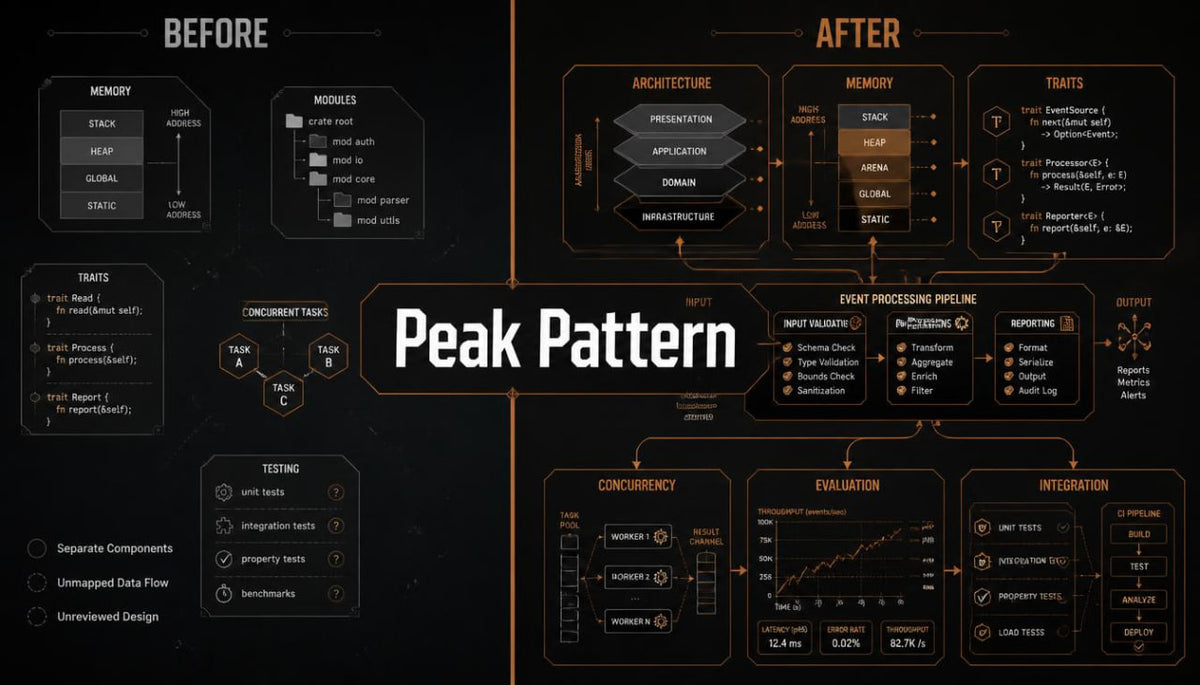
Peak Pattern connects earlier Rust topics through one architectural case study. Its lessons examine memory layout, data ownership, task coordination, and measurement in context. Learners compare alternative implementations and discuss their technical trade-offs. Guided activities introduce targeted testing, benchmarking principles, and the review of low-level code. The final workshop combines planning, implementation, evaluation, and technical documentation in one exercise.
3. What's Inside
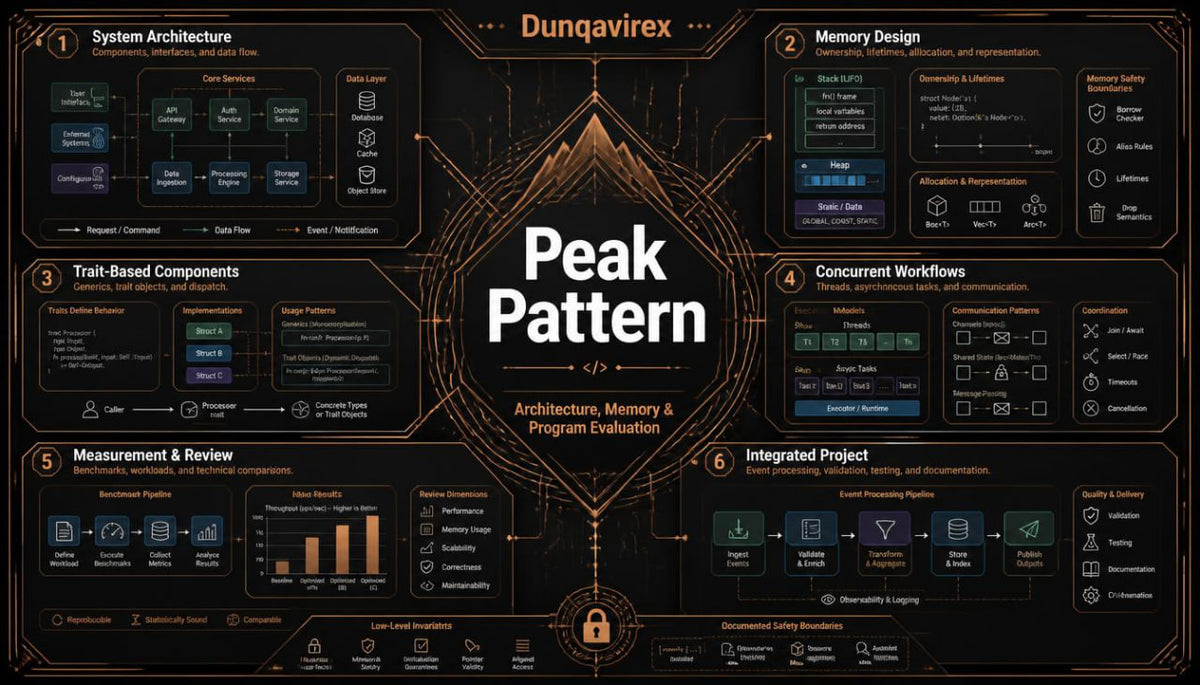
Module 1 — Architecture Under the Microscope
Map responsibilities across data models, modules, and public interfaces. Examine dependency direction, data validation, and the implications of different architectural arrangements.
Module 2 — Memory and Representation
Review stack and heap concepts, ownership, borrowing, lifetimes, and memory layout. Examine common data representations and compare allocation, copying, and sharing strategies.
Module 3 — Trait-Driven Components
Explore generic interfaces, associated types, trait objects, and static versus dynamic dispatch. Practice selecting suitable abstractions for individual program components.
Module 4 — Threads and Task Coordination
Revisit channels, shared ownership, locking, and asynchronous functions. Analyze task boundaries, cancellation, error propagation, and resource contention.
Module 5 — Measurement Before Revision
Introduce benchmark design, repeatable workloads, and interpretation of timing results. Learn why measurements require context before making implementation changes.
Module 6 — Boundaries of Low-Level Rust
Examine the purpose of unsafe, invariants, raw pointers, and documented safety assumptions at a conceptual level. Review isolated examples and compare approaches using safe Rust.
Module 7 — The Peak Integration Studio
Build a guided event-processing application with typed records, validation, parallel tasks, and a reporting layer. Review data movement, write tests, compare design variants, and document architectural choices.
Additional Learning Materials
Annotated code studies, architectural decision worksheets, technical review prompts, and a final project checklist support the lessons.
4. Who Is This For?
Peak Pattern is designed for learners familiar with ownership, traits, generics, modular design, testing, and concurrent or asynchronous programming. It is appropriate for individuals interested in examining architectural decisions, program behavior, and technical evaluation. The course assumes previous experience completing connected Rust programming projects.
5. What You'll Learn
-
Diagram component responsibilities and data flow.
-
Compare memory representations and allocation choices.
-
Select between generic and trait-object interfaces.
-
Evaluate communication and synchronization designs.
-
Develop repeatable benchmarks and interpret results.
-
Explain invariants surrounding bounded low-level code.
-
Write tests for interacting components and error paths.
-
Document architectural trade-offs.
-
Coordinate asynchronous and concurrent operations.
-
Develop an integrated Rust programming project.
6. Guarantee
We offer a 30-day money-back guarantee on all paid digital courses and educational materials available through our store.
If you are not satisfied with your purchase, you may request a full refund within 30 calendar days of the original purchase date.
As our courses are delivered digitally, there is no need to return any physical items. Receiving, downloading, or opening the course materials does not affect your eligibility for a refund under this policy.
Refunds will be issued to the original payment method. Processing times may vary depending on your bank or payment provider.
Our 30-day money-back guarantee is provided in addition to your rights under applicable consumer protection laws and does not limit those rights.
Self-paced learning overview
- 📦 Digital file available after purchase
- 🔄 Long-term availability
- 🛡️ Secure checkout
- 🔄 Content updated in 2026
Share